
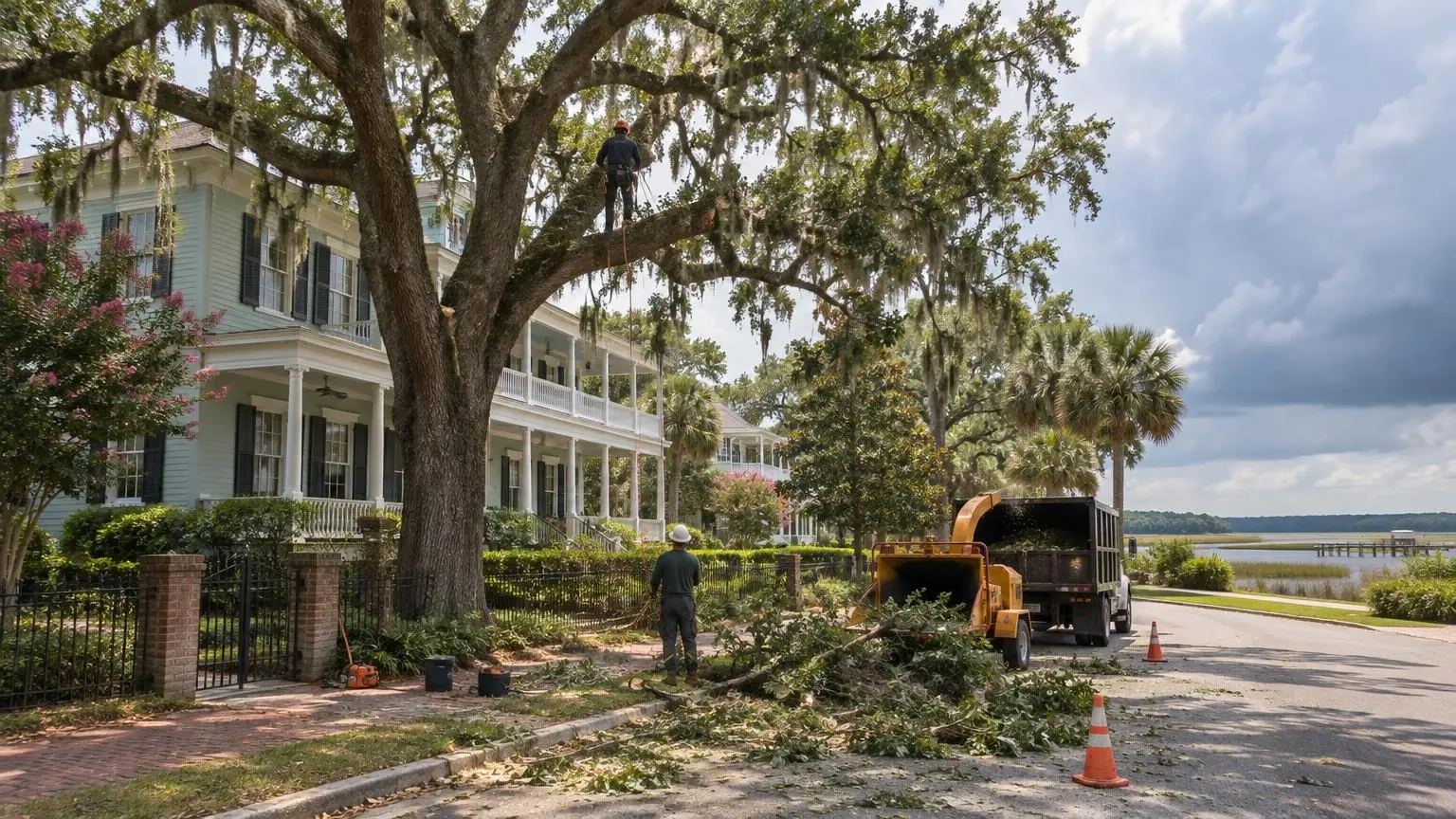
Live oaks, pines, palmettos and storm season
Tree Service in Charleston, SC
Removal, pruning, storm cleanup and stump grinding, planned around grand tree rules, hurricane season and soft Lowcountry ground.
- Free estimates, in person, for homes in Charleston and nearby towns
- Line-item quote you can compare
- Wood, brush and stump plan settled up front
Tree Care for a City Built at Sea Level
Good tree service in Charleston starts with knowing what grows here and what knocks it down. The city sits about three feet above sea level where the Ashley, Cooper and Wando rivers meet the harbor, and almost half of its yearly rain falls between June and September, mostly in thunderstorms. Hurricane season brings the rest of the risk. The trees that shade the peninsula, West Ashley and the sea islands are big, old and close to houses, and the ground under them is often wet. Most of what we do comes down to three questions: is the tree sound, what is under it, and what do the city's rules allow?
Hugo still shapes how people see their trees
Hurricane Hugo came ashore at Sullivan's Island just after midnight on September 22, 1989, as a Category 4 storm. Downtown Charleston recorded sustained winds of 87 mph with a gust of 108 mph, and about three quarters of the homes in the historic district were damaged. Francis Marion National Forest, just north of the city, lost about 75 percent of its marketable timber. People who lived through it remember which trees went over and which stood. Clemson Extension's list of the most wind-resistant trees reads like a Charleston street: live oak, southern magnolia, sabal palmetto and bald cypress. Water oaks, pecans, Bradford pears, maples and pines are on the list of trees that broke or blew over in recent storms.
Live oaks, laurel oaks and the difference between them
A live oak in an open yard can grow 40 to 80 feet tall and 60 to 100 feet wide, and some live 200 to 300 years. They are worth keeping, and they rarely need more than careful pruning: shortening long limbs that reach over a roof, clearing dead wood and keeping weight balanced. Laurel oaks look similar from the street but behave very differently. University of Florida research notes that they do not wall off decay well, so old pruning cuts, trunk wounds and root damage can turn into hollows, and older laurel and water oaks blow down more often in hurricanes. If a big oak in your yard has mushrooms at the base, a cavity or dead limbs at the top, we will tell you which kind it is and what that means.
Grand trees and city street trees
The City of Charleston protects any tree 8 inches or more in diameter at 4.5 feet, except multi-stem crape myrtles, and calls a tree 24 inches or more a grand tree, excluding pines and sweet gums. On lots used for single-family homes or duplexes, trees under 24 inches need no removal permit. A grand tree needs an inspection first, and a permit is issued when it is hazardous, diseased, irreparably injured or damaging the house. Pruning a protected or grand tree needs no permit, but the city says it must be done by a qualified tree service to national pruning standards. Trees in public places, such as most trees between the sidewalk and the curb, belong to the city, and no one may cut or prune them without written permission from the Department of Parks.
Asian longhorned beetle
Asian longhorned beetle was first found in South Carolina in May 2020, by a homeowner in Hollywood, and again in Mount Pleasant in August 2025. Federal and state quarantines cover parts of Charleston and Dorchester counties, and as of July 2026 more than 9,000 infested trees had been removed. Red maple is its favorite host here, but it also attacks elm, willow, birch, sycamore, poplar and several others. Inside the quarantine, firewood and woody host material half an inch or more across cannot leave without being processed under the rules. If your address is in or near a quarantine zone, we plan the wood handling before we cut.
What an estimate covers
- Species, size and trunk diameter, measured where the city measures it
- Decay signs: cavities, fungus, cracks, dead tops, lifted soil
- What sits underneath: roof, porch, pool, driveway, the neighbor's side
- Power lines, and whether Dominion Energy needs to be called first
- Permit status: grand tree, street tree or neither
- What happens to the logs, brush, chips and stump, and a written price
Our Tree Services
Six services cover most of the tree work Charleston homeowners ask about, from one palmetto to a storm-split oak.
Tree Removal
Dead, hollow, leaning or unwanted trees taken down in sections, with grand tree permits handled first.
Learn more →Tree Trimming & Pruning
Live oaks, magnolias and shade trees pruned to the ANSI A300 standard: weight reduced, dead wood out, roof cleared.
Learn more →Stump Grinding
Stumps ground below the surface, roots chased where they matter, and the hole backfilled so you can plant or lay sod.
Learn more →Emergency Storm Tree Service
Trees on roofs, cars and driveways after hurricanes and thunderstorms, handled in order of danger.
Learn more →Palm Tree Trimming
Sabal palmettos and other palms cleaned up to the ANSI standard: dead fronds and seed stalks out, green crown left full.
Learn more →Hurricane Prep Pruning
Trees near the house checked and pruned before June: weight off long limbs, dead wood out, weak trees flagged.
Learn more →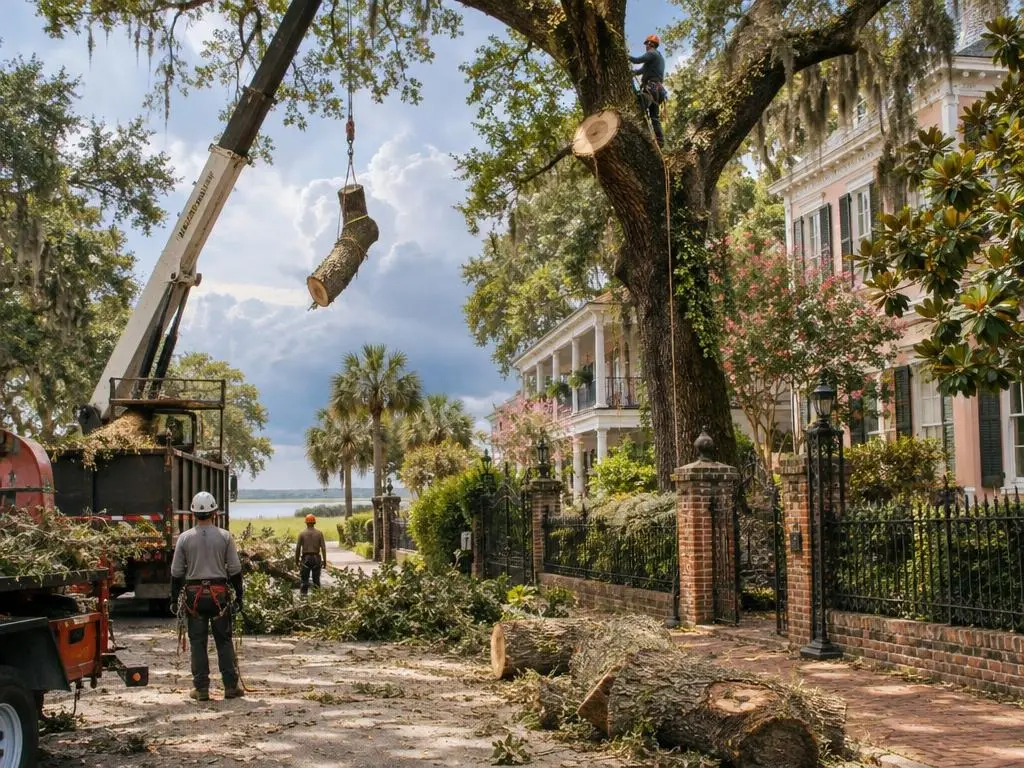
Common Questions
Do I need a permit to cut down a tree in Charleston, SC?
It depends on the tree and the lot. Inside the City of Charleston, trees under 24 inches in diameter on single-family or duplex lots need no permit, while grand trees (24 inches and up, except pines and sweet gums) need a city inspection and permit, issued when the tree is hazardous, diseased, badly injured or damaging the house. Unincorporated Charleston County and nearby towns have their own rules. We measure the tree and tell you which applies.
How much does tree service cost in Charleston?
National cost guides put most tree removals between about $400 and $1,200, with trees over 60 feet from about $850 to $2,000 or more, and trimming one tree from about $400 to $900. Big live oaks over houses, tight backyards and dead wood push the price up. We give a written price after seeing the tree.
Can I trim the oak in front of my house?
If it stands in the public right of way, usually between the sidewalk and the curb, it belongs to the city. Charleston's code says no one may cut, prune, climb or remove a city tree without written permission from the director of the Department of Parks. If it is on your side of the property line, pruning needs no permit, even for a grand tree.
When is the best time for tree trimming in the Lowcountry?
For most shade trees, late winter while they are dormant works well, and it gets work done well before hurricane season starts in June. Clemson Extension suggests mid-to-late summer for pruning live oaks to reduce oak wilt risk. Dead, cracked or hanging limbs should come off whenever you find them.
Is Spanish moss killing my tree?
Almost certainly not. Clemson Extension explains that Spanish moss is an epiphyte: it uses the tree for support and takes no water or nutrients from it. Heavy moss on a thin, struggling tree is usually a sign of another problem, so we look at the roots, trunk and crown instead.
Who removes a tree on a power line?
Dominion Energy says homeowners should never hire a private contractor to work near power lines, and only qualified line clearance workers may work within 10 feet of them. Call the utility first. For the line to your house, Dominion will disconnect service at no cost so the tree can be removed safely, and then we can do the rest.
Is there a tree company near me that handles Asian longhorned beetle wood?
Yes, we work in and around the quarantine areas and plan the wood handling before cutting. Inside the quarantine, firewood and host wood half an inch or more across must be processed under state and federal rules or taken to an approved site, such as the Bees Ferry Road convenience center. If you see round, pencil-sized exit holes in a maple, report it to the state program at 843-973-8329.
Why Homeowners Call Charleston Tree Service Pros
Permits checked before the quote
We measure the trunk and tell you if the tree is a grand tree or a city street tree before any price is set.
Species matters here
A sound live oak and a hollow laurel oak can look alike. We tell you which one you have and what that means for keeping it.
Pruning to the standard
Cuts follow ANSI A300: no topping, no lion-tailing, no flush cuts, and no spikes on trees that stay.
One written price
Each tree, the work, the cleanup and the price are on the quote. Changes are agreed in writing first.
Where You Will Find Our Crews
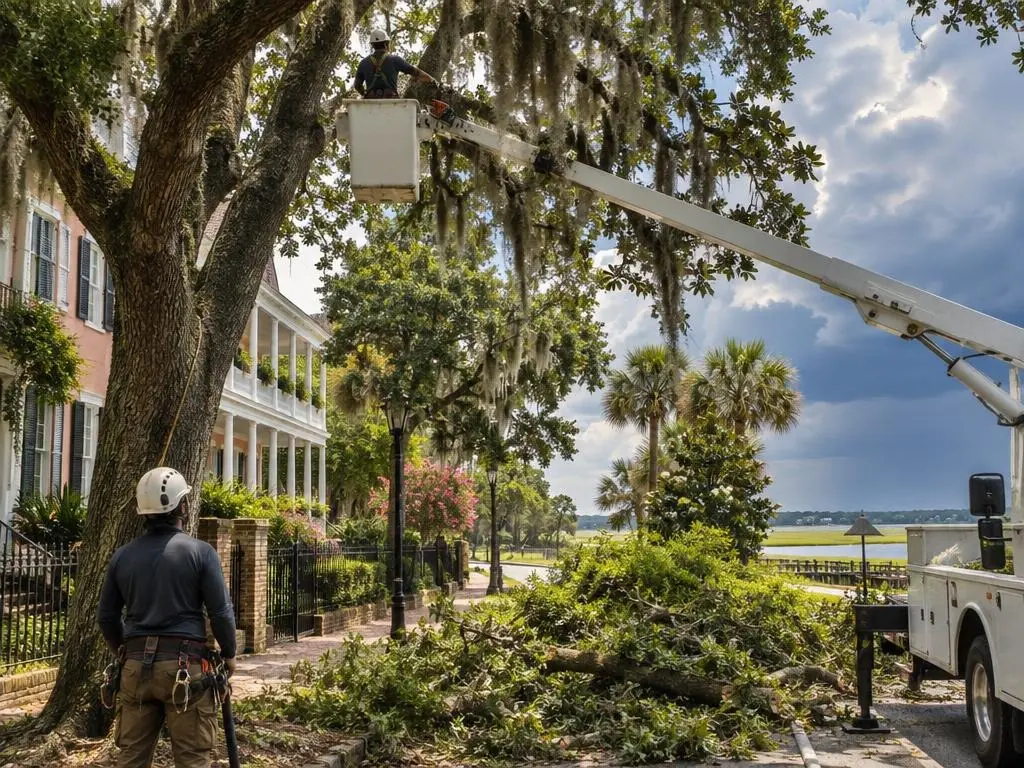
Charleston is the center of our service area, and the city itself is spread out: the peninsula and its historic neighborhoods, West Ashley across the Ashley River, James Island and Johns Island to the south, and Daniel Island and the Cainhoy peninsula across the Cooper. From there we work in North Charleston, Mount Pleasant, Summerville, Goose Creek, Hanahan, Folly Beach, the barrier islands and the towns along the rivers. The trees and the storms are much the same across the Lowcountry. The rules are not: Charleston County, Mount Pleasant, North Charleston and the island towns each set their own tree protections, and the Asian longhorned beetle quarantine covers only some areas. Each town page explains what we know about that place.
- Tree Service in Charleston, SC
- Tree Service in North Charleston, SC
- Tree Service in Mount Pleasant, SC
- Tree Service in Summerville, SC
- Tree Service in Goose Creek, SC
- Tree Service in Hanahan, SC
- Tree Service in James Island, SC
- Tree Service in Johns Island, SC
- Tree Service in Folly Beach, SC
- Tree Service in Isle of Palms, SC
- Tree Service in Sullivan's Island, SC
- Tree Service in Moncks Corner, SC
- Tree Service in Ladson, SC
- Tree Service in Ravenel, SC
- Tree Service in Hollywood, SC
- Tree Service in Kiawah Island, SC
- Tree Service in Seabrook Island, SC
- Tree Service in Lincolnville, SC
- Tree Service in Daniel Island, SC
- Tree Service in West Ashley, SC
- Tree Service in Awendaw, SC
- Tree Service in Meggett, SC
- Tree Service in Wadmalaw Island, SC
- Tree Service in Dewees Island, SC
Ask for a Written Tree Service Quote
Free on-site estimates across Charleston and the Lowcountry.